Bedtime Routine Visual Schedule: Ending the Day With Tomorrow's Plan
A bedtime routine visual schedule is a short strip of pictures that shows the steps between "time for bed" and being in bed — pyjamas, teeth, toilet, into bed — in the same order every night, so the child follows the pictures instead of a run of spoken reminders from a tired adult at the end of the day.
In our house bedtime starts around seven or eight in the winter and closer to nine in the summer, and for a long time the hard part wasn't the teeth or the pyjamas but the first move: getting off the screen. Since we started using pictures for it, bedtime has been a lot less stressful, though the change that did the most wasn't on the bedtime strip at all — it was being clear, before bed, about what the next day held. Both are below, along with the routine itself at three levels of detail.
A five-step bedtime routine
This is what StepPics produced when I typed "getting ready for bed", at its default level of detail:
- Put on pyjamas
- Put toothpaste on brush
- Brush your teeth
- Go to the toilet
- Get into bed
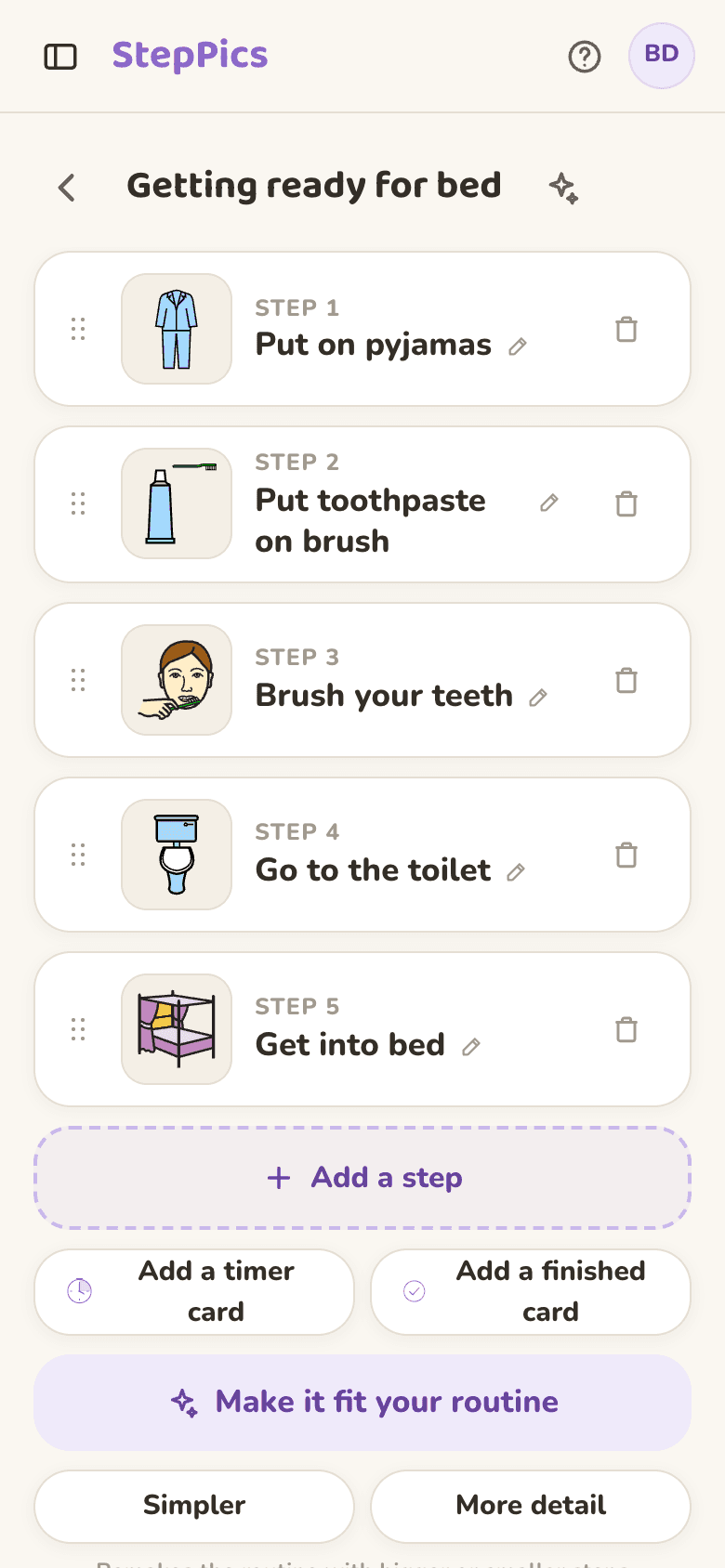
It's worth noticing what the list leaves out as much as what it keeps. Toothpaste gets its own card because it's a real, separate job that a lot of children stall on, while "walk to the bathroom" doesn't get one because nobody needs a picture to tell them to do it. A bedtime strip should carry the steps a child actually needs prompting for and nothing else, which for most children is somewhere between three and six.
The same bedtime at three levels of detail
The right length depends on the child rather than the routine, so it helps to see the same bedtime at both ends. Tapping Simpler on that routine gave three cards:
- Brush your teeth
- Put on pyjamas
- Get into bed
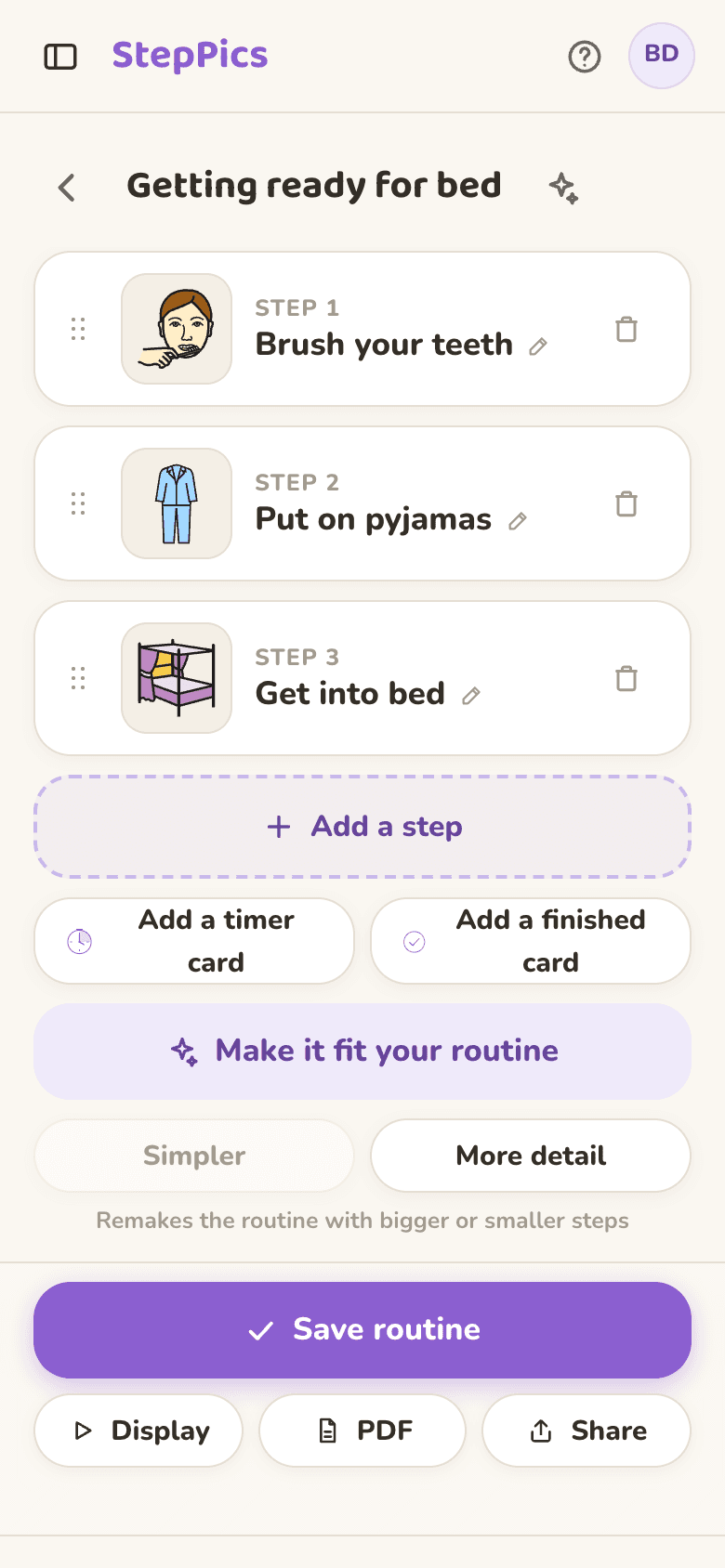
That's the version for a child who is new to picture schedules, or who reads a long strip as a long list of demands. Tapping More detail went the other way, to six, splitting the bathroom into its real parts:
- Put toothpaste on brush
- Brush your teeth
- Rinse your mouth
- Put on pyjamas
- Put clothes in basket
- Get into bed
The longer version suits a child who can follow a strip on their own and is working towards doing the whole routine without an adult in the room, which is where these schedules are most useful in the long run. If a single step keeps stalling, the fix is usually to split that one step rather than lengthening the whole strip — the morning routine post walks through doing that for toothbrushing.
Most bedtimes stall at the start
For a lot of families, the bathroom isn't the battle; the battle is leaving whatever came before it, whether that's a tablet, the television or a game that isn't finished. In StepPics, Make it fit asks which part of the routine is the struggle, and choosing "getting started" re-plans the routine to spend more of its cards on the opening:
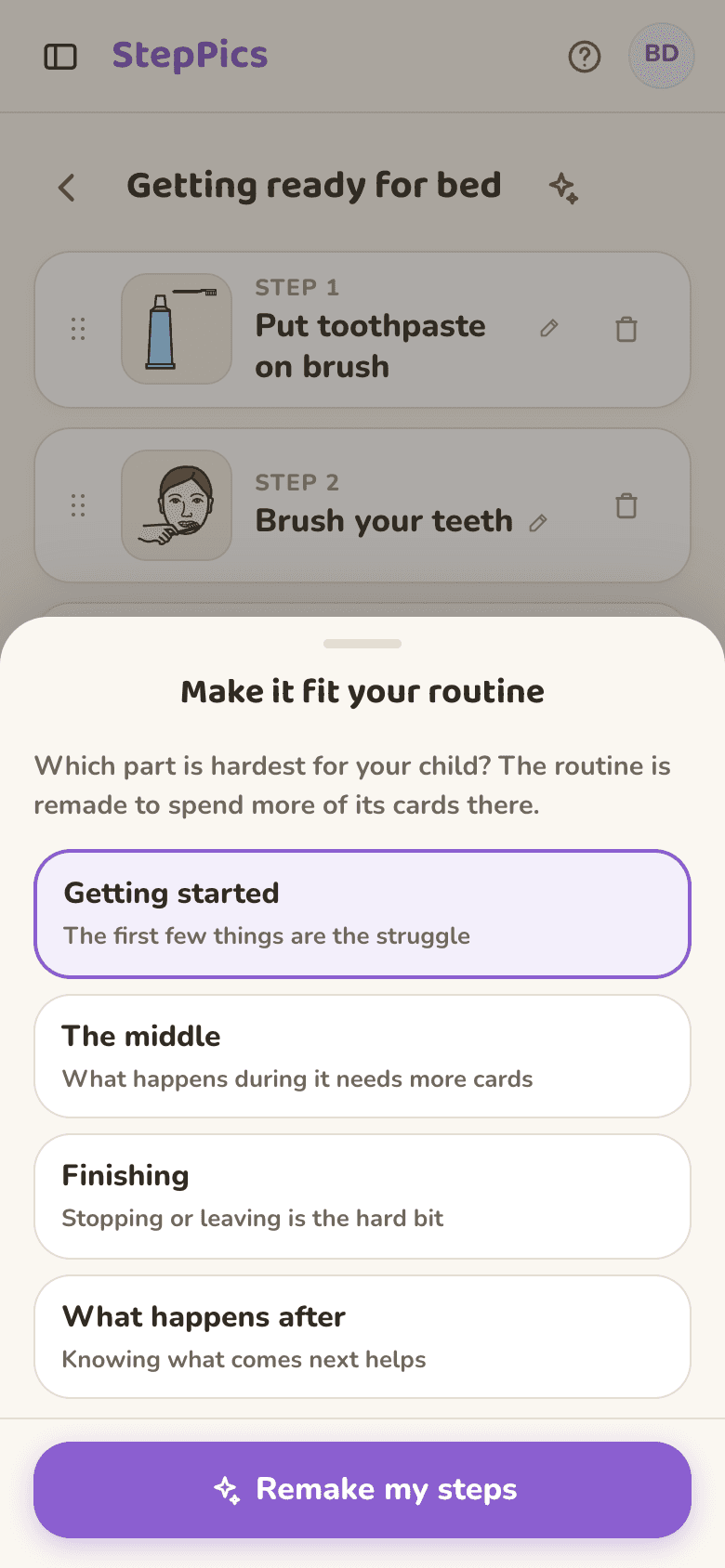
- Put toys away
- Go to the bathroom
- Put toothpaste on brush
- Brush your teeth
- Put on pyjamas
- Get into bed
The first card is the one to make your own. In our house the thing being left was a screen rather than toys, so it's worth renaming the card to name what your child is actually leaving — "tablet off", "TV off" — because that turns the hardest moment of the evening into a step agreed in advance instead of an instruction that arrives without warning. Once the screen was a picture on the strip rather than a parent's announcement, bedtime stopped starting with a fight.
End the day with tomorrow
The biggest positive change for us came from the end of bedtime rather than the start: being clear about expectations for the evening and for the next morning, so that what was planned for tomorrow was settled before sleep instead of discovered at breakfast. I've mentioned the habit in the back-to-school post — thirty seconds with tomorrow's pictures the evening before — but bedtime is where it does its work.
It can go on the bedtime strip itself. When I asked StepPics for "bedtime, ending with looking at the plan for tomorrow", it gave:
- Put toys away
- Take a bath
- Put on pyjamas
- Brush your teeth
- Get into bed
- Look at tomorrow's plan
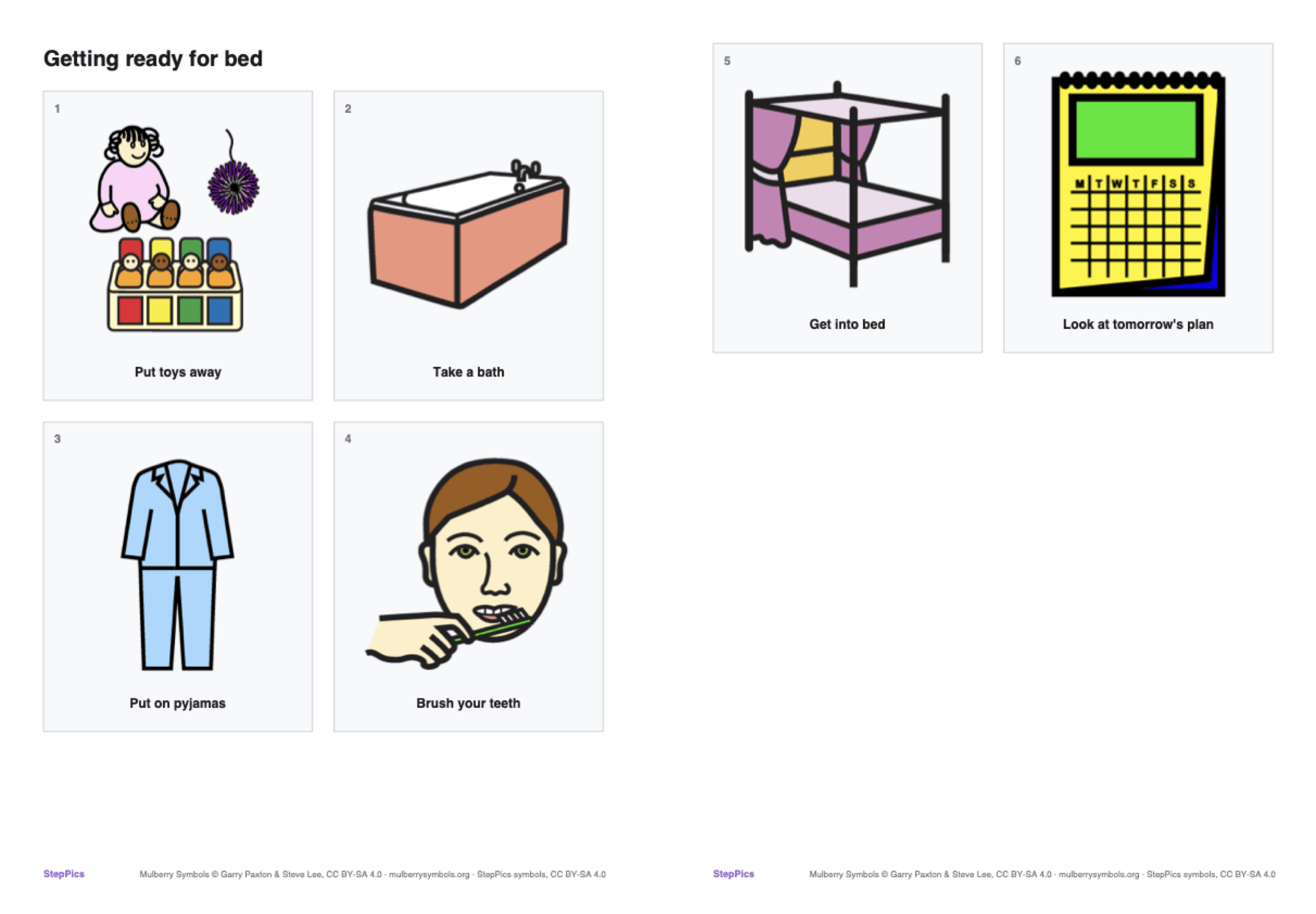
The last card works best when there's an actual plan to look at: tomorrow's day, in pictures, in the same symbols as the bedtime strip. That can be a printed timetable for the next day or the Plan your day view in StepPics, which shows the day's routines in order. It doesn't need to be detailed — something as short as school, then swimming, then home is plenty. What it removes is the uncertainty a child takes to bed, and the morning negotiation that uncertainty would otherwise turn into.
What didn't work for us
Lullabies and calming music are some of the most common bits of bedtime advice, and they did nothing for us. That isn't a verdict on them — wind-down music clearly works in plenty of houses — but it's worth saying because a lot of bedtime advice is about making the room calmer, when in our case the problem was not knowing what came next. If you've tried the calming routine and the evening still falls apart at the same point, it may be worth looking at whether the evening and the next day are clear before you look at the playlist.
When bedtime moves
Bedtime here shifts by an hour or more between winter and summer, and the clocks changing twice a year moves it again. The useful thing about a picture routine is that the times can move while the cards stay exactly the same: same order, same last card, just a different number on the clock. If the clock change unsettles your child, the common advice from charities such as Together Trust is to move bedtime by ten to fifteen minutes a day over the week beforehand. For us, though, the change in time mattered much less than whether the plan was clear.
Does a visual schedule help with sleep?
Honestly, the evidence is about the routine more than the sleep. Sleep problems are very common in autistic children — studies put it at roughly half to four in five, against far fewer in non-autistic children (Hart Barnett et al., 2022). That same study found a visual schedule increased how well one autistic child followed the bedtime routine, with the effect holding over time; it's a single-child study and it measured following the routine, not sleep. The stronger evidence is for consistency itself: a study of over 10,000 young children across 14 countries found that the more nights a week a family kept a bedtime routine, the better the children slept, although it wasn't a study of autistic children and can't prove cause. In the UK, NICE guidance on autism in under-19s recommends a sleep plan, including a regular bedtime routine, as the first step, with medication considered only if that plan hasn't helped.
So a picture strip isn't a sleep treatment, and if sleep itself is the problem it's worth talking to your GP or paediatrician. What it does is make the routine the same every night, which is the part a parent can actually control — more on the wider research in do visual schedules work?